
William Hull
Medium
Classification
Department
Smithsonian Collection
Museum
Smithsonian American Art Museum
Credit
National Portrait Gallery, Smithsonian Institution
Accession Number
NPG.86.51
Rights
Public Domain
Tags
Art Historical Context
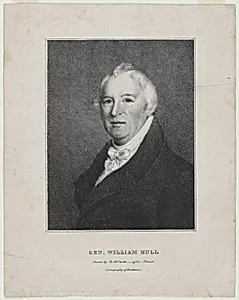
In the National Portrait Gallery's collection at the Smithsonian American Art Museum *William Hull* (c. 1825) is a compelling print portrait by Sara Ann Freeman Clarke, a artist active from 1808 to around 1890. Created when Clarke was just a teenager, this work captures the likeness of William Hull, a prominent figure tagged with connections to the Revolutionary War, Michigan Territory, and Connecticut. As a print, it reflects the era's accessible reproductive techniques, allowing portraits of notable Americans to circulate widely beyond original paintings. William Hull (1753–1825) was a Revolutionary War veteran who rose to brigadier general, later serving as governor of the Michigan Territory. His legacy is tied to the War of 1812, where he controversially surrendered Detroit to British forces, leading to a court-martial—though he was later pardoned. This portrait, made near the end of his life, preserves his image as a symbol of early American military and frontier leadership. Clarke's choice of print medium underscores the democratic impulse of 19th-century portraiture, making historical icons like Hull approachable to the public. A poignant glimpse into post-Revolutionary identity, it invites visitors to reflect on the complexities of American heroism. (198 words)