
William III Prince of Orange
1654
Medium
Silver
Dimensions
Diam.: 63 mm.
Classification
Medals and Plaquettes
Culture
Dutch
Department
European Sculpture and Decorative Arts
Museum
Metropolitan Museum of Art, New York, NY
Credit
Gift of Assunta Sommella Peluso, Ada Peluso, and Romano I. Peluso, in memory of Ignazio Peluso, 2003
Accession Number
2003.406.15
Rights
Public Domain
Tags
Art Historical Context
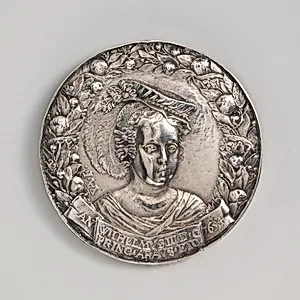
This exquisite silver medal, titled *William III Prince of Orange*, was crafted in 1654 by the artist Peter van Abeele Measuring just 63 mm in diameter it belongs to the tradition of portrait medals and plaquettes, small-scale sculptures that served as portable commemorations of notable figures. Van Abeele, known for his intricate metalwork, captures the young prince—born in 1650—in a detailed profile portrait, surrounded by symbolic motifs like fruit and leaves, evoking abundance and nobility. Dated to the height of the Dutch Golden Age, the medal reflects the political turbulence following the death of William III's father, William II, in 1650. As heir to the House of Orange, the infant prince symbolized hopes for the restoration of stadtholder power amid republican tensions. Such medals were prized collectibles among Europe's elite, blending portraiture with allegorical elements to affirm lineage and legacy. Housed in the Metropolitan Museum of Art's Department of European Sculpture and Decorative Arts, this piece—gifted in 2003—highlights silver's enduring appeal for its luster and fine engraving techniques. Van Abeele's craftsmanship invites close inspection, revealing the delicate interplay of portraiture and ornament that defined Dutch decorative arts. A testament to 17th-century ingenuity, it offers visitors a tangible glimpse into royal ambition and artistic precision.