
William Mather Smith
ca. 1810
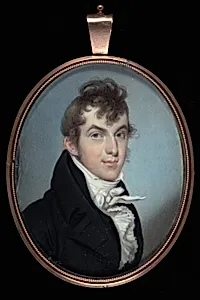
Medium
Painting-Miniature
Classification
Painting-Miniature
Department
Smithsonian Collection
Museum
Smithsonian American Art Museum
Credit
Smithsonian American Art Museum, Museum purchase through the Catherine Walden Myer Fund
Accession Number
1944.7.2
Rights
Public Domain
Tags
About this artwork
William Mather Smith (1787-1864) was the only son of Connecticut governor and congressman John Cotton Smith (1765-1845), of Sharon, Connecticut. William was a precocious boy, entering Yale at the age of twelve and graduating in the class of 1805. A lay preacher, Smith founded one of the nation’s first Sunday schools, which he ran for fifty years. He also conducted services in the Sharon church for three decades. This miniature was painted the year Smith married Helen Livingston, and was probably...
Art Historical Context
This delicate miniature portrait by Archibald Robertson captures William Mather Smith (1787–1864) in a bust-length format around 1810, showcasing the intimate scale and fine detail typical of early 19th-century American portrait miniatures. Often painted in watercolor on ivory, these small-scale works were prized as personal treasures, worn as jewelry or kept in cases for loved ones, reflecting the era's neoclassical elegance and status among the elite. Smith, the only son of Connecticut governor and congressman John Cotton Smith, was a remarkable prodigy who entered Yale at age twelve and graduated in 1805. A devoted lay preacher, he founded one of America's earliest Sunday schools in Sharon, Connecticut, running it for fifty years, and led services at the local church for three decades—highlighting his lifelong commitment to education and faith amid the young nation's religious revival. Likely commissioned to commemorate Smith's marriage that year to Helen Livingston—whose companion miniature by an unknown artist is also in the collection ([see 1944.7.3])—this artwork offers a window into personal milestones of early American gentry life, blending family legacy with pious achievement.