
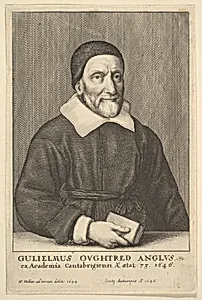
William Oughtred (frontispiece from William Oughtred's "The Key of the Mathematicks New Forged and Filed," 1647)
Medium
Etching and drypoint, only state
Dimensions
Plate: 6 7/16 × 4 3/16 in. (16.4 × 10.7 cm) Sheet: 6 9/16 × 4 3/8 in. (16.7 × 11.1 cm)
Classification
Prints
Department
Drawings and Prints
Museum
Metropolitan Museum of Art, New York, NY
Credit
Gift of Carl J. Ulmann, 1924
Accession Number
24.57.74
Rights
Public Domain
Tags
Art Historical Context
This delicate etching and drypoint portrait serves as the frontispiece for Rev. William Oughtred influential 1647 mathematical treatise, *The Key the Mathematicks Newed and Filed*. Created in 1644 by the Bohemian printmaker Wenceslaus Hol, it captures Oughtred, a revered English mathematician and clergyman, in a dignified profile view. Oughtred (1574–1660) was a pivotal figure in 17th-century mathematics, with popularizing the slide rule and future luminaries like Christopher Wren. The image fittingly fronts his book, which demystified complex mathematical concepts for English readers amid the intellectual ferment of the Scientific Revolution. Hollar's technique shines in this sole known state: precise etching defines Oughtred's features and scholarly attire, while drypoint's velvety burr adds rich texture to hair and clothing, evoking intimacy despite the small plate size (6 7/16 × 4 3/16 in.). As a period portrait print, it exemplifies the era's fusion of art and science, immortalizing a thinker whose innovations bridged Renaissance humanism and modern computation. Now in the Metropolitan Museum of Art's Drawings and Prints collection, it invites visitors to ponder how such engravings disseminated knowledge in pre-digital times.
About the Artist
Wenceslaus Hollar|The Rev. William Oughtred · 1607–1677
Wenceslaus Hollar (1607-1677) was a prolific Bohemian etcher who became one of the most accomplished printmakers of the seventeenth century. Born in Prague, he trained under Matthäus Merian in Frankfurt before entering the service of Thomas Howard, Earl of Arundel, in 1636. Hollar spent most of his career in England, where he produced approximately 2,740 etchings documenting an extraordinary range...