
William Shakespeare
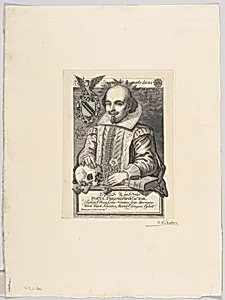
Medium
Engraving; sixth state of nine
Dimensions
Plate: 6 3/16 × 4 5/8 in. (15.7 × 11.7 cm) Sheet: 12 1/16 × 8 15/16 in. (30.7 × 22.7 cm)
Classification
Prints
Department
Drawings and Prints
Museum
Metropolitan Museum of Art, New York, NY
Credit
Harris Brisbane Dick Fund, 1917
Accession Number
17.3.569
Rights
Public Domain
Tags
Art Historical Context
This 1876 engraving presents a striking portrait of William Shakespeare, created by British printmaker Charles William Sherborn. Produced as the sixth state of nine, the print reveals the careful, iterative process of engraving, where the artist refined lines and details across multiple impressions. Measuring just over six inches in height, the intimate plate size invites close viewing, while the larger sheet allows for the inclusion of text or margins typical of fine art prints from the period. The image incorporates symbolic elements such as a skull and Shakespeare’s coat of arms, blending portraiture with memento mori imagery. These motifs underscore themes of mortality and legacy that have long surrounded the playwright’s posthumous reputation. Sherborn’s precise linework captures the textures of fabric, hair, and heraldic detail, demonstrating the technical mastery of 19th-century reproductive engraving. Acquired by the Metropolitan Museum of Art through the Harris Brisbane Dick Fund in 1917, this work reflects the Victorian era’s fascination with Shakespeare as both literary giant and cultural icon. As a print, it made an idealized vision of the Bard accessible to a wider audience beyond painted originals.
About the Artist
Charles William Sherborn|Thomas Brooker|William Shakespeare (British|British|British) · 1831 |1840 |1564 –1912 |1877 |1616
British, London 1831–1912 London|British, active 1840–77|British, Stratford-upon-Avon 1564–1616 Stratford-upon-Avon