
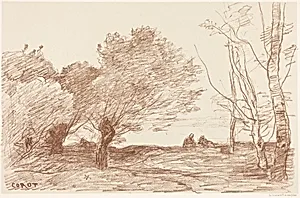
Willows and White Poplars (Saules et peupliers blancs)
Medium
lithograph
Classification
Department
CG-E
Museum
National Gallery of Art, Washington, D.C.
Credit
Rosenwald Collection
Accession Number
1943.3.2838
Rights
Public Domain
Art Historical Context
Jean-Baptiste-Camille Cor's *Willows and White Popl (Saules et peupliers)*, created in 1871, is a delicate lithograph that captures the artist's lifelong passion for the natural world. A leading figure in the Barbizon school of landscape painting, Corot bridged Romanticism and Impressionism with his soft, atmospheric renderings of light and foliage. By his later years, at age 75, he had mastered evoking the subtle poetry of trees and riversides, motifs that recur throughout his oeuvre. This print exemplifies lithography's revolutionary technique, where Corot drew directly on a lithographic stone with greasy crayon, allowing for fluid, painterly lines and tonal gradations that mimic his oil sketches. Popularized in the 19th century, lithography democratized art, enabling artists like Corot to produce affordable multiples of their visions. Here, the willows and poplars likely sway in a gentle breeze, embodying the serene, contemplative mood that defined French plein-air traditions. Housed in the National Gallery of Art's Rosenwald Collection (Department CG-E), this work highlights Corot's versatility beyond canvas, inviting visitors to appreciate how 19th-century printmaking preserved the ephemeral beauty of nature for generations. A testament to his enduring influence, it reminds us of the quiet magic in everyday landscapes.
About the Artist
Jean-Baptiste-Camille Corot · 1796–1875
Jean-Baptiste-Camille Corot, born on July 16, 1796, in Paris to a prosperous bourgeois family—his father a former wig-maker turned draper and his mother a successful milliner—was initially apprenticed in the textile trade but pursued art from his mid-twenties with family support. He studied under the neoclassical landscapist Achille Etna Michallon in 1821–1822, who taught him to sketch outdoors in...