
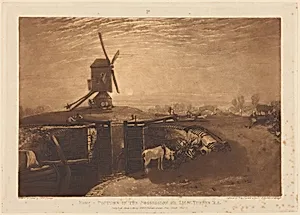
Windmill and Lock
published 1811
Medium
etching and mezzotint
Classification
Department
CG-E
Museum
National Gallery of Art, Washington, D.C.
Credit
Rosenwald Collection
Accession Number
1943.3.8155
Rights
Public Domain
Art Historical Context
"Windmill and Lock" is a captivating print created through a collaboration between the visionary British artist J.M.W. Turner and engraver William Say, published 1811. Housed in the National Gallery of Art's Rosenwald (Department CG-E), this and mezzotint exemplifieser's mastery of light and atmosphere in landscape depiction. Turner, a leading figure in Romanticism, often sketched the evolving English countryside, blending natural beauty with early industrial elements like windmills and canal locks. The medium—etching for precise lines combined with mezzotint's velvety tonal gradations—allowed for dramatic contrasts of shadow and glow, mimicking Turner's oil paintings. Mezzotint, a "dark manner" technique where engravers scrape highlights from a blackened plate, was ideal for capturing the moody skies and reflective waters Turner adored, making prints accessible to a wider audience beyond original watercolors. This work invites visitors to ponder Britain's transition from agrarian to industrial eras, frozen in Turner's poetic vision. A gem for print enthusiasts, it showcases how 19th-century reproductive techniques democratized great art. (178 words)