
Windsor, No. 2
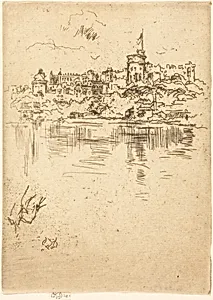
Medium
etching
Dimensions
overall (trimmed to plate): 13.2 × 9.6 cm (5 3/16 × 3 3/4 in.)
Classification
Department
CG-W
Museum
National Gallery of Art, Washington, D.C.
Credit
Rosenwald Collection
Accession Number
1943.3.8612
Rights
Public Domain
Art Historical Context
James McNeill Whistler’s *Windsor, No. 2* (1887) is a delicate etching capturing the atmospheric charm of Windsor, likely evoking the town’s historic castle or riverside vistas along the Thames. Measuring just 13.2 × 9.6 cm—trimmed neatly to the plate’s edge—this intimate print exemplifies Whistler’s mastery of etching, a technique where acid etches fine lines into a metal plate to create subtle gradations of tone and texture. Produced during his later career in London, it reflects his lifelong passion for printmaking, honed since his pioneering Thames etchings in the 1850s and 1860s. Whistler, a leading figure in the Aesthetic movement, championed “art for art’s sake,” prioritizing harmony of color and form over narrative. His etchings, like this one, achieve a painterly softness through virtuoso line work, blending realism with impressionistic mood. This piece belongs to his series exploring British landscapes, showcasing his innovative use of aquatint for velvety shadows and highlights. Housed in the National Gallery of Art’s Rosenwald Collection, *Windsor, No. 2* invites visitors to appreciate etching’s accessibility as fine art. Its small scale rewards close inspection, revealing Whistler’s subtle genius in evoking place and light—a timeless gem for print enthusiasts.
About the Artist
James McNeill Whistler · 1834–1903
James Abbott McNeill Whistler (1834-1903) was an American-born painter and printmaker who became a leading figure in the Aesthetic Movement and pioneer of Tonalism and Japonisme. He revolutionized art by championing "art for art's sake" and treating paintings as visual equivalents of musical compositions, titling works as "arrangements," "harmonies," and "nocturnes" to emphasize formal qualities o...