
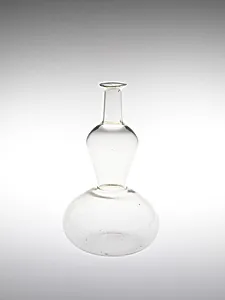
Wine Bottle
Unknown Artist
19th century
Medium
Translucent glass
Dimensions
H. 7 3/4 in. (19.7 cm); Diam. of base 4 1/2 in. (11.4 cm); Diam. of mouth 1 1/4 in. (3.2 cm)
Classification
Glass
Culture & Period
Japan · Edo period (1615–1868)
Department
Asian Art
Museum
Metropolitan Museum of Art, New York, NY
Credit
Purchase, Friends of Asian Art Gifts, 2002
Accession Number
2002.361.3
Rights
Public Domain
Art Historical Context
This elegant wine bottle from 19th-century Japan exemplifies the late Edo period's (1615–1868) fascinating encounter with Western influences. Crafted from translucent glass, it stands at 7 3/4 inches tall with a base diameter of 4 1/2 inches and a mouth 1 1/4 inches, making it a practical vessel likely used for sake or imported wines. Acquired by the Metropolitan Museum of Art through Friends of Asian Art in 2002, it in the Asian Art department a rare example of Japan's nascent glassmaking tradition. Glass production emerged in Japan during the mid-19th century, introduced via Dutch traders at Nagasaki and spurred by domestic innovation in Edo (modern Tokyo). Before this, ceramics and lacquer dominated, so this bottle highlights a shift toward transparent, lightweight materials that allowed light to play across its surface, adding a subtle luminescence prized in Japanese aesthetics. Artisans likely employed blowing or molding techniques adapted from European methods, achieving a smooth, even translucency that speaks to growing technical prowess. Culturally, such objects bridged isolationist policies with impending modernization, foreshadowing the Meiji era's embrace of industry. Visitors will appreciate its understated beauty—a testament to how everyday items captured Japan's adaptive spirit amid global change.