
Wine cooler (one of a pair)
ca. 1735–36
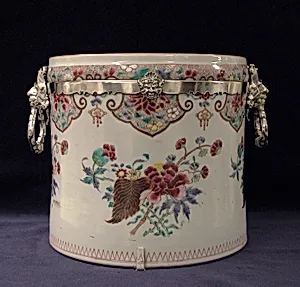
Medium
Hard-paste porcelain; silver
Dimensions
Overall: 8 × 8 1/4 in. (20.3 × 21 cm)
Classification
Metalwork-Silver In Combination
Culture
Chinese porcelain with German, Augsburg mounts
Department
European Sculpture and Decorative Arts
Museum
Metropolitan Museum of Art, New York, NY
Credit
Gift of Mrs. Charles Wrightsman, 2004
Accession Number
2004.520a, b
Rights
Public Domain
Tags
Art Historical Context
This exquisite wine cooler, one of a pair crafted around 1735–36, exemplifies the luxurious fusion of Eastern and Western artistry during the height of European chinoiserie. Made of fine Chinese hard-paste porcelainrenowned for its durability and translucent glow—the vessel is adorned with delicate motifs of faces and flowers, evoking the intricate porcelain traditions of the Qing dynasty. German silversmith Elias Adam Augsburg elevated it with ornate silver mounts, including handles and decorative elements that secure and embellish the porcelain body, measuring a compact 8 × 8¼ inches. Augsburg was a premier center for such elaborate silverwork in 18th-century Europe, where craftsmen like Adam specialized in combining imported Chinese porcelain with Rococo-style metalwork to create opulent tableware for the aristocracy. These wine coolers, used to chill bottles at grand banquets, highlight the global trade networks that brought porcelain across continents, transforming functional objects into status symbols. The silver's gleaming surfaces contrast beautifully with the porcelain's subtle colors, showcasing technical mastery in both media. A generous gift to The Metropolitan Museum of Art in 2004 from Mrs. Charles Wrightsman, this piece invites visitors to appreciate the cultural dialogue between China and Europe, where beauty met utility in the Rococo era.