
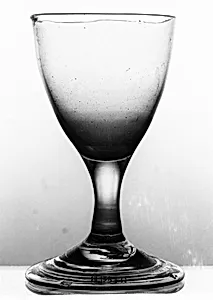
Wine Glass
Unknown Artist
18th century
Medium
Free-blown lead glass
Dimensions
H. 4 in. (10.2 cm)
Classification
Wine glass
Culture
American, possibly
Department
The American Wing
Museum
Metropolitan Museum of Art, New York, NY
Credit
Gift of Frederick W. Hunter, 1913
Accession Number
13.179.74
Rights
Public Domain
Art Historical Context
This delicate wine glass, crafted in the 18th by an unknown American artist—or possibly one influenced by American traditions—exemplifies early colonial glassmaking artistry. Standing just 4 inches (10.2 cm) tall, it was made from free-blown lead glass, technique where molten glass is on a blowpipe and shaped solely by the artisan's breath and tools, without molds. The addition of lead oxide created the sparkling clarity and refractive quality akin to fine European crystal, making such pieces prized luxuries for the emerging American elite. In the context of 18th-century America, this glass reflects the colonies' growing sophistication in domestic crafts, as glasshouses like those in New Jersey and Pennsylvania began producing tableware inspired by British styles. Though modest in size, it would have graced formal dinners, symbolizing refinement amid the Revolutionary era's social aspirations. Its presence in The American Wing of The Metropolitan Museum of Art, gifted by Frederick W. Hunter in 1913, highlights its role in preserving everyday artifacts that illuminate colonial life. Today, this unassuming goblet invites us to appreciate the skilled hands behind anonymous objects, bridging the gap between utility and elegance in early American material culture.