
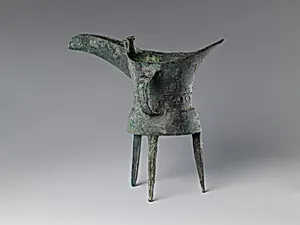
商 青銅爵|Wine warmer (Jue)
Unknown Artist
ca. 16th century BCE
Medium
Bronze
Dimensions
H. 5 3/4 in. (14.6 cm); W. with spout 6 1/8 in. (15.6 cm); D. with handle 2 3/4 in. (7 cm)
Classification
Metalwork
Culture & Period
China · Shang dynasty (ca. 1600–1046 B.C.)
Department
Asian Art
Museum
Metropolitan Museum of Art, New York, NY
Credit
Purchase, Bequest of Dorothy Graham Bennett, 2003
Accession Number
2003.432
Rights
Public Domain
Art Historical Context
This elegant bronze *jue*, or wine warmer, hails from China's Shang dynasty (ca. 1600–1046 B.C.), a formative era of early Bronze Age innovation around the 16th century BCE Standing just 5 3/4 inches tall a spout width of 6 1/8 inches, this compact metalwork vessel exemplifies the Shang elite's mastery of bronze casting. Produced using the sophisticated piece-mold technique—where clay molds were pieced together and fired—this method allowed for intricate designs and mass production of ritual objects, marking a pinnacle of ancient Chinese metallurgy. Ritual bronzes like this *jue* held profound cultural significance, used in ancestral worship and sacrificial ceremonies to warm and pour wine offerings. The vessel's distinctive form, with its spout, handle, and likely tripod legs (typical of jue), facilitated precise libations, symbolizing the Shang rulers' divine connection to forebears. Adorning such pieces often featured taotie masks or zoomorphic motifs, underscoring their role as status symbols and conduits to the spiritual realm. Today, housed in the Metropolitan Museum of Art's Asian Art Department through a generous purchase, this artifact offers a window into Shang society's hierarchical rituals and technological prowess, reminding us of bronze's enduring legacy in Chinese art.