
Wing Brooch
Unknown Artist
100–200
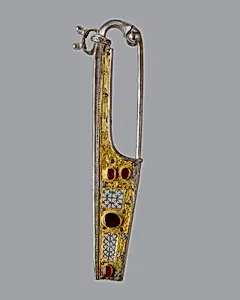
Medium
Silver, gold, four carnelians
Dimensions
Overall: 7 11/16 x 1 15/16 x 1 9/16 in. (19.6 x 4.9 x 3.9 cm)
Classification
Metalwork-Silver
Culture
Roman
Department
Medieval Art
Museum
Metropolitan Museum of Art, New York, NY
Credit
Purchase, Alastair B. Martin, William Kelly Simpson, Scher Chemicals Inc., Levy Hermanos Foundation Inc., Shelby White, and Max Falk Gifts, in honor of Katharine R. Brown, 1998
Accession Number
1998.76
Rights
Public Domain
Art Historical Context
This exquisite Wing Brooch, crafted by an unknown Roman artisan between 100 and 200 AD, exemplifies the refined metalworking skills of the early Roman Empire. Shaped like outstretched bird wings, this silver fibula—measuring about 7 11/16 inches across—was likely used to fasten cloaks or tunics, blending practicality with ornamental flair. Its form evokes the natural world, a common motif in Roman jewelry symbolizing flight, speed, or divine protection. The brooch's construction highlights sophisticated techniques: a silver body overlaid with gold accents and adorned with four vibrant carnelian stones, prized in antiquity for their rich red hue and believed protective qualities. Carnelians, sourced from regions like India via Roman trade routes, added luxury and color contrast, showcasing the empire's vast networks and elite craftsmanship in granulation and inlay work. Housed in the Metropolitan Museum of Art's Medieval Art department, this piece bridges Roman innovation and later traditions, reflecting daily life among the Roman elite. Such brooches were status symbols, worn by both men and women, offering a glimpse into a world where artistry elevated the everyday.