
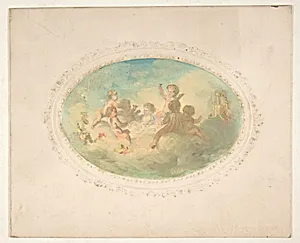
Winged putti at a banquet
second half 19th century
Medium
Oil on embossed card
Classification
Drawings
Department
Drawings and Prints
Museum
Metropolitan Museum of Art, New York, NY
Credit
Dodge Fund, 1967
Accession Number
67.827.437
Rights
Public Domain
Tags
Art Historical Context
In the opulent tradition of 19th-century French decorative arts, *Winged Putti at a Banquet* a whimsical scene of cherubic figures reveling amid abundance. Created by Jules-Edmond-Charlesachaise and Eugène Gourdet in the second of the 1800s, this artwork features playful putti—those endearing, winged infants derived from classical mythology and Renaissance iconography—gathered around a lavish feast. Putti often symbolized joy, love, and the divine frolics of the gods, evoking the Baroque exuberance of artists like Rubens while nodding to neoclassical revivals popular in Victorian-era Europe. Rendered in oil on embossed card, the piece stands out for its innovative medium: the textured, raised surface mimics ornate relief sculpture, lending a sculptural depth to the painted forms. This technique bridged painting and printmaking, ideal for the era's demand for affordable yet luxurious decorative objects. Housed in the Metropolitan Museum of Art's Drawings and Prints department (acquired via the Dodge Fund in 1967), it reflects the 19th-century fascination with antiquity amid industrialization, inviting viewers to savor its lighthearted charm and masterful interplay of light on embossed highlights.
About the Artist
Jules-Edmond-Charles Lachaise|Eugène-Pierre Gourdet · 1897–1897
Jules-Edmond-Charles Lachaise, born Jules Lachaise on September 2, 1836, in Paris, emerged as a prominent French painter and draughtsman specializing in lavish interior decorations during the Second Empire and beyond. Little is known about his early life and formal training, though he married Berthe Gourdet in 1866, forging a close professional partnership with her brother, the decorator Eugène-Pi...