
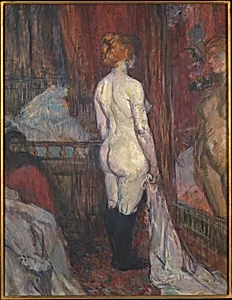
Woman before a Mirror
Henri de Toulouse-Lautrec, 1897
About this artwork
Henri de Toulouse-Lautrec *Woman before a Mirror*1897) captures the intimate, unflinching gaze of Parisian demimonde life during the Belle Époque. in oil on cardboard—a medium the artist favored for its portability and spontaneity—this intimate work (24½ × 18½ in.) depicts a nude, likely a prostitute, contemplating her reflection. Toulouse-Lautrec, a Post-Impressionist master known for chronicling Montmartre's cabarets and brothels, drew from his frequent visits to these worlds, blending empathy with raw observation. The painting's significance lies in its bold exploration of female vulnerability and vanity, themes echoed in the mirror motif symbolizing self-examination amid societal margins. Lautrec's loose, expressive brushstrokes and vivid colors—hallmarks of his style influenced by Japanese prints—reject academic idealism, favoring psychological depth over prettification. This piece reflects fin-de-siècle fascination with modernity's underbelly, humanizing figures often sensationalized. Now in the Metropolitan Museum of Art's European Paintings collection (The Walter H. and Leonore Annenberg Collection, 2002), it invites visitors to ponder the humanity behind the glamour of 1890s Paris. A testament to Lautrec's legacy, it reminds us how art can illuminate hidden lives with compassion and candor.