
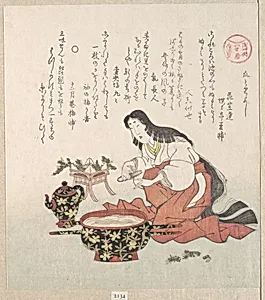
Woman Cutting Her Nails after GatHering Herbs
19th century
Medium
Woodblock print (surimono); ink and color on paper
Dimensions
8 3/16 x 7 5/16 in. (20.8 x 18.6 cm)
Classification
Prints
Culture & Period
Japan · Edo period (1615–1868)
Department
Asian Art
Museum
Metropolitan Museum of Art, New York, NY
Credit
H. O. Havemeyer Collection, Bequest of Mrs. H. O. Havemeyer, 1929
Accession Number
JP2134
Rights
Public Domain
Tags
Art Historical Context
In the serene world of Edo-period Japan (1615–1868), Kubo Shunman's *Woman Cutting Her Nails after Herbs* captures a quiet moment of everyday grace. Created in the 19th century, this woodblock print (surono) showcases a woman in traditional attire, tending to her nails post-harvest, her herb basket nearby. Shunman, a master of ukiyo-e—the "pictures of the floating world"—excelled in luxurious, privately commissioned prints, often produced for poetry societies or New Year's greetings, blending artistry with subtle literary elegance. Surimono like this one stand out for their refined techniques: vibrant inks and colors layered on paper through meticulous woodblock carving, achieving delicate textures and subtle gradients. The small scale (8 3/16 x 7 5/16 in.) invites close viewing, highlighting Shunman's skill in bijin-ga (images of beautiful women), where poise and natural beauty reflect Japan's appreciation for transience and harmony in daily life. Unlike mass-produced ukiyo-e, surimono's exclusivity underscores their cultural prestige. Housed in the Metropolitan Museum of Art's Asian Art Department as part of the H. O. Havemeyer Collection (1929 bequest), this print offers a window into Edo women's routines, evoking mindfulness amid nature's bounty. A gem for admirers of Japanese printmaking's poetic intimacy.
About the Artist
Kubo Shunman · 1757–1820
Japanese, 1757–1820