
Woman Dancer in Daimyo's Palace
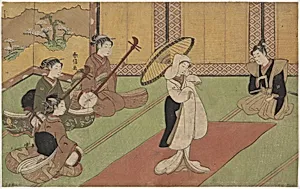
Medium
Woodblock print; ink and color on paper
Dimensions
Horizontal chūban; Image: 7 1/4 × 12 3/8 in. (18.4 × 31.4 cm)
Classification
Prints
Culture & Period
Japan · Edo period (1615–1868)
Department
Asian Art
Museum
Metropolitan Museum of Art, New York, NY
Credit
H. O. Havemeyer Collection, Bequest of Mrs. H. O. Havemeyer, 1929
Accession Number
JP1645
Rights
Public Domain
Tags
Art Historical Context
Suzuki Harunobu's *Woman Dancer in Daimyo's Palace is a captivating woodblock print from Japan's Edo period (16151868), showcasing the artist's mastery of ukiyo, the "pictures of the floating world" that celebrated fleeting pleasures like beauty, theater, and entertainment. Harunobu (1725–1770), a pioneer of full-color nishiki-e prints, revolutionized the medium in the 1760s by introducing multi-block color printing, allowing vibrant inks to layer delicate hues on paper. This horizontal chūban format (about 7¼ × 12⅜ in.) was ideal for intimate, collectible scenes, making art accessible beyond elite circles. The print depicts a graceful woman dancer in the opulent setting of a daimyo's palace—a feudal lord's residence—evoking the refined world of kabuki theater and courtly performances. Tags highlight musical instruments, underscoring the cultural fusion of dance, music, and visual spectacle central to Edo urban life. Harunobu's subtle lines and soft colors bring elegance to the dancer's poise, reflecting Japan's appreciation for bijin-ga, or images of beautiful women. Housed in the Metropolitan Museum of Art's Asian Art Department as part of the H. O. Havemeyer Collection (1929), this work exemplifies ukiyo-e's enduring influence on global art, from Impressionism to modern design. Visitors will appreciate its glimpse into 18th-century Japan's vibrant performing arts.
About the Artist
Suzuki Harunobu · 1725–1770
Suzuki Harunobu (c. 1725-1770) was a Japanese ukiyo-e artist who revolutionized woodblock printing by developing nishiki-e—full-color prints using multiple woodblocks—in 1765. Before Harunobu, Japanese prints were limited to two or three colors; his innovation unleashed the entire artist's palette, transforming ukiyo-e into the vibrant art form that would later captivate Western artists from Manet...