
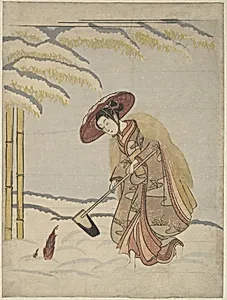
鈴木春信画 雪中に筍を掘る女 見立孟宗|Woman Digging Bamboo Shoots in the Snow, or Parody of Meng Zong (Mōsō), from Twenty-Four Paragons of Filial Piety
ca. 1765
Medium
Woodblock print; ink and color on paper
Dimensions
Vertical chūban; Image: 11 1/8 × 8 3/8 in. (28.3 × 21.3 cm)
Classification
Prints
Culture & Period
Japan · Edo period (1615–1868)
Department
Asian Art
Museum
Metropolitan Museum of Art, New York, NY
Credit
The Howard Mansfield Collection, Purchase, Rogers Fund, 1936
Accession Number
JP2439
Rights
Public Domain
Tags
Art Historical Context
Suzuki Harunobu *Woman Digging Bamboo Shoots in the Snow or Parody of Meng (Mōsō)*, created around 1765, is a delightful woodblock print from Japan's Edo period (16151868). Part of the series *Twenty-Four Paragons Filial Piety*, playfully reimagines a classic Chinese Confucian tale. In the original story, the devoted son Meng Zong braves a snowy winter to dig bamboo shoots for ailing mother, embodying extreme filial piety. Harun, a master of ukiyo-e—the "pictures of the floating world" genre—transforms this into a mitate, or parody, featuring a graceful woman laboring in the snow, her kimono dusted with flakes, blending reverence with everyday beauty. This vertical chūban print (about 11 × 8 inches) showcases Harunobu's groundbreaking innovation in full-color nishiki-e ("brocade pictures"). Around 1765, he pioneered multi-block printing techniques, layering vibrant inks to achieve subtle gradients and luminous effects, revolutionizing Japanese printmaking. The delicate portrayal of the woman amid swirling snow and bamboo evokes both the harshness of winter and quiet determination, highlighting themes of women's work and resilience in urban Edo life. Housed in the Metropolitan Museum of Art's Asian Art collection, this piece captures ukiyo-e's cultural pulse: accessible art for the masses that fused moral tales with sensual elegance, influencing global aesthetics for centuries.
About the Artist
Suzuki Harunobu · 1725–1770
Suzuki Harunobu (c. 1725-1770) was a Japanese ukiyo-e artist who revolutionized woodblock printing by developing nishiki-e—full-color prints using multiple woodblocks—in 1765. Before Harunobu, Japanese prints were limited to two or three colors; his innovation unleashed the entire artist's palette, transforming ukiyo-e into the vibrant art form that would later captivate Western artists from Manet...