
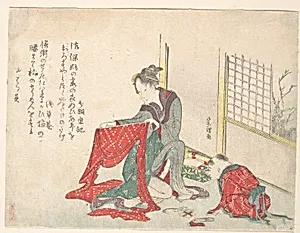
Woman Folding Cloth
1760–1849
Medium
Woodblock print (surimono); ink and color on paper
Dimensions
5 1/8 x 6 13/16 in. (13 x 17.3 cm)
Classification
Prints
Culture & Period
Japan · Edo period (1615–1868)
Department
Asian Art
Museum
Metropolitan Museum of Art, New York, NY
Credit
Henry L. Phillips Collection, Bequest of Henry L. Phillips, 1939
Accession Number
JP3003
Rights
Public Domain
Tags
Art Historical Context
Katsushika Hokus (1760–1849), one of Japan's most celebrated ukiyo-e masters created *Woman Folding Cloth* during Edo period (1615–1868). This intimate woodblock print, a surimono—a luxurious, privately commissioned format often produced for New Year's greetings or poetry albums—measures just 5 1/8 x 6 13/16 inches. Rendered in vibrant ink and color on paper it captures a serene domestic moment, likely featuring women and boys engaged in everyday folding, evoking the quiet beauty of ordinary life. Surimono like this exemplify Hokusai's genius for precise lines, subtle color gradients, and dynamic compositions, techniques honed through woodblock printing's collaborative process of carving and printing. Unlike mass-produced ukiyo-e, surimono boasted high-quality paper, mica flecks, and embossing for tactile elegance, making them cherished collector's items among Edo Japan's literati. Housed in the Metropolitan Museum of Art's Asian Art collection (Henry L. Phillips Bequest, 1939), this print reflects ukiyo-e's cultural role in democratizing art, blending artistry with poetry and seasonality. It invites viewers to appreciate the artistry in the mundane, a hallmark of Hokusai's vast oeuvre of over 30,000 works.
About the Artist
Katsushika Hokusai · 1760–1849
Katsushika Hokusai (1760-1849) stands as one of history's most influential artists, a Japanese master who revolutionized the ukiyo-e woodblock print tradition and profoundly shaped Western art. Born in the Katsushika district of Edo (modern-day Tokyo) to an artisan family, Hokusai lived through nearly nine decades of extraordinary creative evolution, adopting over thirty different artistic names t...