
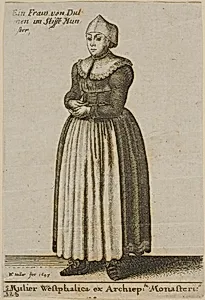
Woman of Westphalia
Medium
Etching on gray Asian paper
Dimensions
Sheet, trtimmed within platemark: 9 × 6.2 cm (3 9/16 × 2 1/2 in.)
Classification
etching
Department
Prints and Drawings
Museum
Art Institute of Chicago
Accession Number
160061
Rights
Public Domain
Art Historical Context
Wenceslaus Hollar's *Woman of Westphalia* (1643) is a delicate etching that captures the essence of 17th-century regional fashion from Germany's Westphalia region. on uncommon gray Asian paper, this print measures just 9 × 6.2 cm, showcasing Hollar's mastery of etching technique. As a Bohemian artist who fled the Thirty Years' War and settled in England under royal patronage, Hollar produced thousands of prints, including detailed costume studies like this one, which document everyday attire with remarkable precision. Etching allowed Hollar to render fine textures—the crisp folds of the woman's apron, the subtle sheen of her bonnet, and the intricate patterns of her sleeves—with a Baroque attention to realism and ornament. Printed on Asian paper, likely imported via trade routes, the work gains a subtle tonal depth that enhances its atmospheric quality, a choice reflecting the experimental printmaking of the era. Housed in the Art Institute of Chicago's Prints and Drawings department, this piece highlights Hollar's role as a visual anthropologist, preserving cultural identities amid Europe's turbulent wars. For visitors, it offers a window into forgotten fashions, inviting closer inspection of its exquisite detail.
About the Artist
Wenceslaus Hollar · 1607–1677
Wenceslaus Hollar (1607-1677) was a prolific Bohemian etcher who became one of the most accomplished printmakers of the seventeenth century. Born in Prague, he trained under Matthäus Merian in Frankfurt before entering the service of Thomas Howard, Earl of Arundel, in 1636. Hollar spent most of his career in England, where he produced approximately 2,740 etchings documenting an extraordinary range...