
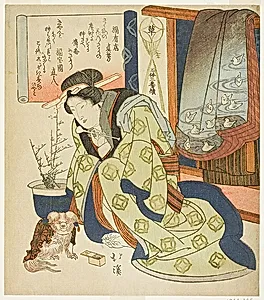
Woman Playing with Pekingese Dog, or The Elegance and Freedom of Script (So), from the series "Three Works of Three Aesthetics (San tai san ban shoku)"
about 1830
Medium
Color woodblock print; surimono
Dimensions
21.9 × 19.5 cm (8 5/8 × 7 11/16 in.)
Classification
woodblock print
Department
Arts of Asia
Museum
Art Institute of Chicago
Accession Number
81051
Rights
Public Domain
Art Historical Context
In the vibrant world of 19th-century Japanese ukiyo-e, Totoya Hokkei's *Woman Playing with Pekingese, or The Elegance Freedom of Script (So captivates with its intimate charm. Created around 1830, color woodblock print is asurimono*—a luxurious, privately commissioned format often produced for New Year's greetings or poetry gatherings among elites. Hokkei, a pupil of the legendary Katsushika Hokusai, mastered these small-scale gems (just 21.9 × 19.5 cm), blending delicate lines with vivid colors to evoke everyday elegance. Part of the series *Three Works of Three Aesthetics (San tai san ban shoku)*, the print poetically pairs a graceful woman playfully engaging a fluffy Pekingese dog—a rare Chinese breed symbolizing refined taste—with the fluid "So" script style of calligraphy. This fusion highlights Japan's Edo-period fascination with *iki* (chic sophistication) and the interplay of visual art and poetry. Surimono like this often featured embossed patterns, mica dusting for shimmer, and custom poems, making them treasured keepsakes. Hokkei's precise carving and layering techniques brought subtle textures to life, from the dog's soft fur to the woman's flowing kimono. Housed in the Art Institute of Chicago's Arts of Asia collection, it offers a window into ukiyo-e's golden age, where art celebrated fleeting joys and cultural harmony.
About the Artist
Totoya Hokkei · 1780–1850
Totoya Hokkei (魚屋 北渓, 1780–1850), born Iwakubo Tatsuyuki in Edo (modern Tokyo), began his life as a humble fishmonger in the Yotsuya Samegahashi district, a trade reflected in his art name "Totoya," meaning fish shop. He transitioned to art through rigorous training, first studying under Kanō Yōsen'in Korenobu, head of the Kobikichō branch of the prestigious Kanō school, where he honed landscape p...