
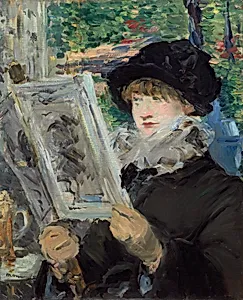
Woman Reading
1880–82
Medium
Oil on canvas
Dimensions
61.2 × 50.7 cm (24 1/16 × 19 7/8 in.); Framed: 83.2 × 73.1 × 9.9 cm (32 3/4 × 28 3/4 × 3 7/8 in.)
Classification
oil on canvas
Department
Painting and Sculpture of Europe
Museum
Art Institute of Chicago
Accession Number
14591
Rights
Public Domain
About this artwork
During the late nineteenth century, Parisian cafés were the gathering places of artists and writers and were ideal locations for observing the urban scene. Many Impressionist paintings depict the Café Nouvelle-Athènes on the rue Pigalle, where two tables were reserved for Édouard Manet and his circle—a group that included the painters Edgar Degas, Claude Monet, Camille Pissarro, and Pierre-Auguste Renoir, and the writers Charles Baudelaire and Émile Zola. At first glance, this fashionably dress...
Art Historical Context
Édouard Manet's *Woman Reading* (188–82), an oil on canvas measuring about 61 × 51 cm, captures an intimate moment of quiet concentration. Housed in the Art Institute of Chicago's Department of Painting and Sculpture of, this modest-scale work exemplifies Manet's late style during his final years, when declining health limited him to smaller, personal compositions. Painted in loose, fluid brushstrokes typical of his oeuvre, the canvas showcases his mastery of light and texture, rendering fabric and skin with a fresh, modern vitality. As a pioneer bridging Realism and Impressionism, Manet often depicted everyday scenes with bold directness, challenging academic conventions. Here, the solitary female figure immersed in a book reflects the era's growing fascination with private leisure amid Paris's bustling modernity. Though intimate in size, the painting's psychological depth and innovative handling of form underscore Manet's influence on artists like the Impressionists, who admired his rejection of traditional finish in favor of spontaneity. This gem invites visitors to ponder the universal allure of reading—a timeless escape—while appreciating Manet's enduring legacy in redefining portraiture for the modern world.