
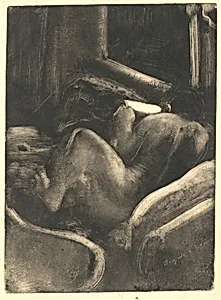
Woman Reading (Liseuse)
c. 1885
Medium
monotype in black ink on cream laid paper
Dimensions
plate: 38 x 27.7 cm (14 15/16 x 10 7/8 in.) sheet: 44.3 x 32.5 cm (17 7/16 x 12 13/16 in.)
Classification
Department
CG-E
Museum
National Gallery of Art, Washington, D.C.
Credit
Rosenwald Collection
Accession Number
1950.16.292
Rights
Public Domain
Art Historical Context
In the late 19th century, Edgar D, a master of capturing fleeting moments, created *Woman Reading (Lise)* around 1885. This intimate monotype in black ink on cream laid (plate: 38 x 27.7 cm) showcases a solitary woman absorbed in her book, embodying Degas' fascination with private, everyday scenes. Unlike his iconic ballet dancers, this work highlights the quiet poetry of domestic life, a theme that resonated during the Impressionist era's shift toward modernity. Degas pioneered monotype printing, applying ink directly to a metal plate and transferring it in a single pull to produce unique, painterly images with rich tonal effects. This experimental technique bridged his skills in drawing, pastel, and oil, allowing spontaneous yet controlled compositions. The cream laid paper enhances the velvety blacks and subtle whites, evoking the soft light of a Parisian interior. Housed in the National Gallery of Art's Rosenwald Collection (Department CG-E), this print exemplifies Degas' innovative printmaking, blending realism and impressionistic spontaneity. Visitors are drawn to its timeless intimacy—a reminder of reading's enduring solace amid the buzz of 1880s urban life.
About the Artist
Edgar Degas · 1834–1917
Edgar Degas (1834-1917) stands as one of the most innovative artists of the nineteenth century, whose distinctive vision transformed how modern life could be depicted on canvas. Born Hilaire-Germain-Edgar De Gas in Paris to a wealthy banking family—his father French, his mother a Louisiana Creole from New Orleans—Degas received a classical education before abandoning law studies in 1855 to pursue ...