
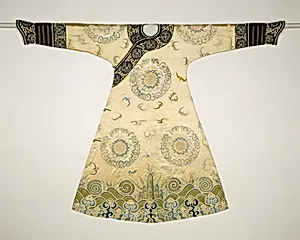
清早期 刺繡百蝠紋女吉服袍|Woman’s ceremonial robe
Unknown Artist
first half 18th century
Medium
Silk and metallic thread embroidery on silk satin
Dimensions
54 x 75 in. (137.2 x 190.5 cm)
Classification
Costumes-Embroidered
Culture & Period
China · Qing dynasty (1644–1911)
Department
Asian Art
Museum
Metropolitan Museum of Art, New York, NY
Credit
Anonymous Gift, 1943
Accession Number
43.119
Rights
Public Domain
Tags
Art Historical Context
This stunning woman’s ceremonial robe, crafted in the first half of the 18 century during the early Qing dynasty (1644–1911), exemplifies the opulent textile arts of imperial China. Made of luxurious silk satin embroidered with silk and metallic threads, the robe measures an impressive 54 x 75 inches, designed to drape elegantly over the body in formal settings. Adorned with a pattern of a hundred bats—known as *bǎi fú* in Chinese—this garment was reserved for joyous occasions like weddings or festivals, reflecting the elite status of its wearer. In Chinese culture, bats are powerful symbols of good fortune, longevity, and happiness, as the word *fú* (bat) is a homophone for *fú* (prosperity). The repetition of a hundred bats amplifies wishes for boundless blessings, a motif popular among Manchu nobility under Qing rule. Such robes were not mere clothing but statements of harmony between humanity and the cosmos, often worn by women of high rank to invoke divine favor. The embroidery technique showcases extraordinary skill: intricate stitching with metallic threads that catch the light, creating a shimmering effect on the satin ground. This piece, now in the Metropolitan Museum of Art’s Asian Art collection (anonymous gift, 1943), highlights the Qing era’s mastery of silk weaving and needlework, blending functionality with profound symbolism for today’s visitors.