
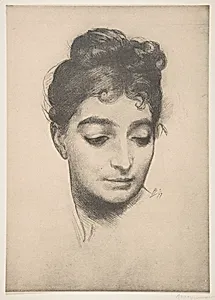
Woman's Head, from "L'Estampe Moderne"
1897–99
Medium
Photolithograph
Dimensions
Mount: 16 1/16 × 12 1/16 in. (40.8 × 30.6 cm) Sheet: 11 9/16 × 8 3/16 in. (29.4 × 20.8 cm)
Classification
Prints
Department
Drawings and Prints
Museum
Metropolitan Museum of Art, New York, NY
Credit
Gift of Bella C. Landauer, 1928
Accession Number
28.78.2(20)
Rights
Public Domain
Tags
Art Historical Context
Félix Bracquemond's *Woman's Head*, created between 1897 and 1899, is a striking contribution to *L'Estampe Moderne a prestigious French album series that showcased contemporary artists' innovative prints. As a leading 19th-century etcher and proponent of Japonisme—the European fascination with Japanese aesthetics—Bracquemond brought his mastery of line and form to this intimate portrait study. The work captures the subtle contours and expressive features of a woman's face, reflecting the era's interest in psychological depth and naturalism amid the fin-de-siècle artistic ferment in Paris. Printed as a photolithograph, this medium revolutionized printmaking by combining photography's precision with lithography's tonal richness, enabling vibrant, affordable reproductions of original artworks. At roughly 11½ × 8¼ inches on the sheet, it exemplifies how such techniques democratized high art, bridging elite galleries and broader audiences. Bracquemond's precise rendering highlights the photolithograph's ability to convey texture and light with remarkable fidelity. Today, this piece resides in the Metropolitan Museum of Art's Drawings and Prints department, a gift from Bella C. Landauer in 1928. It invites visitors to ponder the timeless allure of the human visage, a motif echoing from Renaissance portraits to modern abstraction.
About the Artist
Félix Bracquemond · 1833–1914
French, Paris 1833–1914 Sèvres