
Woman's Rank Badge with Wild Goose
Unknown Artist
late 18th–early 19th century
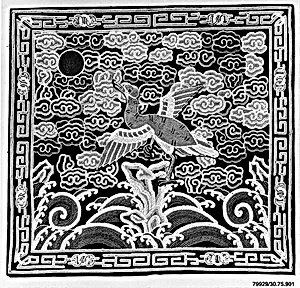
Medium
Silk on silk
Dimensions
8 3/4 x 9 1/4 in. (22.23 x 23.50 cm)
Classification
Textiles-Embroidered
Culture & Period
China · Qing dynasty (1644–1911)
Department
Asian Art
Museum
Metropolitan Museum of Art, New York, NY
Credit
Bequest of William Christian Paul, 1929
Accession Number
30.75.901
Rights
Public Domain
Tags
Art Historical Context
This exquisite Woman's Rank Badge with Wild Goose, crafted in silk on silk during China's Qing dynasty (late 18th– 19th century), the intricate world of imperial textiles. Worn by the wives of civil officials, these embroidered squares—known as *biao*—were essential to formal attire, prominently displayed on robes to signify rank and status. The wild goose motif, rendered in vibrant threads, denoted the seventh rank, a precise symbol within the rigid Qing hierarchy that governed everything from court ceremonies to family prestige. The badge's small size (8 3/4 x 9 1/4 in.) belies its technical mastery: fine embroidery techniques like satin and seed stitches brought the goose to life against a patterned ground, showcasing the skill of anonymous artisans in workshops serving the elite. Silk's luster and durability made it ideal for such garments, blending functionality with artistry. Today, this piece from the Metropolitan Museum of Art's Asian Art collection—bequeathed by William Christian Paul in 1929—offers a window into Qing social order, where even birds carried bureaucratic weight, reminding us of fashion's role in power dynamics.