
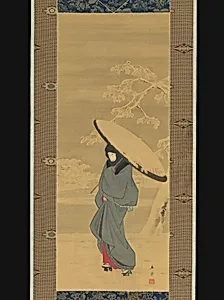
Woman Walking in the Snow
1840s–early 1850s
Medium
Hanging scroll; ink and color on silk
Dimensions
31 1/8 x 12 1/2 in. (79.1 x 31.8 cm)
Classification
Paintings
Culture & Period
Japan · Edo period (1615–1868)
Department
Asian Art
Museum
Metropolitan Museum of Art, New York, NY
Credit
The Howard Mansfield Collection, Purchase, Rogers Fund, 1936
Accession Number
36.100.22
Rights
Public Domain
Tags
Art Historical Context
In the serene world of Edo-period Japan (1615–1868), Utagawa Hirosh captures a poignant moment in *Woman Walking in the Snow (1840s–early 1850s). One of the last great masters of uki-e—the "pictures of the floating world" that celebrated everyday beauty and transience—Hirosh here shifts from his famed woodblock prints to a delicate hanging scroll. This intimate format, meant for private display in homes, invites viewers to contemplate a solitary woman braving a snowy path, her wagasa umbrella shielding her from the gentle flurry. Rendered in ink and color on silk (31 1/8 x 12 1/2 in.), the painting showcases Hiroshige's mastery of atmospheric effects. Subtle gradations of mineral pigments evoke the soft hush of snowfall, while precise ink lines define the woman's flowing kimono and poised figure. Silk's luminous texture enhances the wintry glow, a technique rooted in traditional Japanese painting that prioritizes harmony between human and nature. This work reflects Edo Japan's fascination with bijin-ga (beautiful women) in seasonal settings, embodying *mono no aware*—the pathos of things. Gracefully navigating winter's chill, the woman symbolizes resilience and elegance amid impermanence, offering museum visitors a window into 19th-century urban life. Gifted through The Howard Mansfield Collection at The Metropolitan Museum of Art, it remains a timeless gem of Asian Art.
About the Artist
Utagawa Hiroshige · 1826–1869
Utagawa Hiroshige (1797–1858), born Andō Tokutarō, was the last great master of Japanese ukiyo-e woodblock printmaking and one of the most influential landscape artists in history. Born in Edo (modern Tokyo) into a low-ranking samurai family serving as fire wardens, Hiroshige transformed landscape printmaking into a poetic meditation on nature, weather, and everyday life. His revolutionary approac...