
Woman with a Rake
Jean-François Millet, probably 1856–57
About this artwork
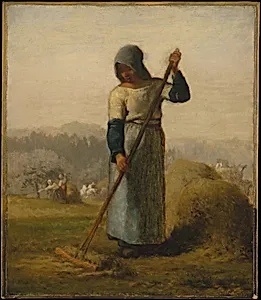
Jean-François Millet's *Woman with a Rake*, painted around 1856–57, captures the quiet dignity of rural labor in mid-19th-century France. A leading figure in the Realist movement and the Barbizon school, Millet elevated everyday peasant life to subjects worthy of fine art, countering the romanticized ideals of earlier painters. This modest oil on canvas (15⅝ × 13½ in.) depicts a woman pausing amid haystacks on a farm, rake in hand, embodying the backbreaking yet resilient world of agricultural workers during a time of rapid industrialization. Millet's masterful use of earthy tones and diffused natural light creates a sense of timeless harmony between human and landscape, with loose brushwork suggesting the texture of hay and worn clothing. The small scale hints at a study for larger compositions, showcasing his skill in intimate, evocative portraits. Far from sentimental, the work underscores the physical toll of farm labor while affirming its nobility—a radical statement in an era dominated by urban elite subjects. Today, housed in the Metropolitan Museum of Art as a 1938 gift from Stephen C. Clark, *Woman with a Rake* invites visitors to reflect on the unsung heroes of the countryside, blending historical insight with profound humanism.