
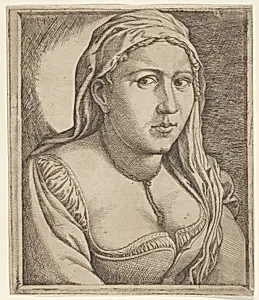
Woman with a Veil
Medium
Etching and engraving
Dimensions
Sheet: 8 7/16 × 7 3/16 in. (21.4 × 18.3 cm)
Classification
Prints
Department
Drawings and Prints
Museum
Metropolitan Museum of Art, New York, NY
Credit
Purchase, Barbara and Howard Fox Gift, 2013
Accession Number
2013.945
Rights
Public Domain
Tags
Art Historical Context
Jan Cornelisz Vermeyen’s “Woman with a Veil” (1545) is a refined example of Northern Renaissance printmaking. Created through the combined techniques of etching and engraving, the small sheet captures delicate textures—from the soft folds of fabric to the subtle modeling of the sitter’s face—demonstrating the artist’s mastery of line and tone. Such prints allowed images to circulate widely among collectors and scholars in the sixteenth century, extending the reach of portraiture beyond painted originals. Vermeyen, active at the courts of Margaret of Austria and Emperor Charles V, frequently explored portraiture that balanced realism with a sense of quiet dignity. The veil, drawn across the woman’s features, lends an air of modesty while inviting viewers to linger on the play of light and shadow. This intimate scale—roughly eight by seven inches—encourages close looking, rewarding the eye with the fine cross-hatching and crisp contours typical of his graphic work. Today in the Metropolitan Museum’s collection, the print offers a window onto mid-sixteenth-century conventions of female representation, where costume and expression conveyed both personal identity and social ideals.