
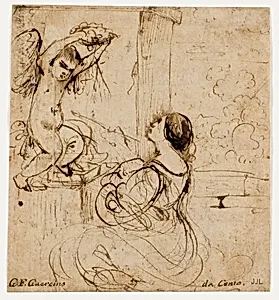
Woman with Putto
n.d.
Medium
Pen wash on cream laid paper
Dimensions
12.4 × 11.4 cm (4 15/16 × 4 1/2 in.)
Classification
ink or chalk wash
Department
Prints and Drawings
Museum
Art Institute of Chicago
Accession Number
123526
Rights
Public Domain
Art Historical Context
In the intimate world of 17th-century Italian drawings, *Woman with Putto* byercino (Giovanni Francescoieri, 1591–1666) captivates with its delicate pen wash on cream laid paper. This sheet, measuring just 12.4 × 11.4 cm, exemplifies the Bolognese artist's mastery as a draftsman in the Baroque era. Guercino, nicknamed "the squinter" for his cross-eyed gaze, was a leading figure in the Carracci-influenced Bolognese school, blending dramatic tenebrism—deep shadows and glowing highlights—with fluid, expressive lines. Rendered in ink wash, a technique using diluted ink brushed for soft tonal gradations akin to watercolor, the work likely served as a preparatory study for a painting or altarpiece. The tender depiction of a woman cradling a putto (a chubby, winged child symbolizing innocence or divine love) evokes devotional themes common in Catholic Counter-Reformation art, inviting contemplation of maternal grace and spirituality. Laid paper, with its textured chain lines, was a favored support for such sketches, preserving the spontaneity of Guercino's hand. Housed in the Art Institute of Chicago's Prints and Drawings department, this undated gem highlights how Guercino's rapid, improvisational drawings bridged his oil paintings and frescoes, offering collectors prized insights into Baroque creativity. Up close, its subtle washes reveal a poetic intimacy perfect for quiet reflection.
About the Artist
Guercino · 1591–1666
Son of a laborer who transported wood. He was called Guercino (squinter), because he was cross-eyed or had a squint in his right eye. Reputedly self-taught early, then an apprentice in the shop of Benedetto Gennari. Patrons included the papal legate at Ferrara and the Archbishop of Bologna. He developed a classical style later in his career. After the death of Guido Reni, Guercino was the leading ...