
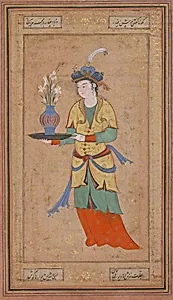
Woman with Vase of Lilies
Unknown Artist
second half 16th century
Medium
Opaque watercolor and gold on paper
Dimensions
H. 12 7/8 in. (32.7 cm) W. 8 5/8 in. (21.9 cm)
Classification
Codices
Department
Islamic Art
Museum
Metropolitan Museum of Art, New York, NY
Credit
Rogers Fund, 1955
Accession Number
55.121.20
Rights
Public Domain
Tags
Art Historical Context
This delicate folio, *Woman with Vase ofies*, hails from the second half the 16th century exemplifies the refined artistry of Islamic manuscript illumination. Created with opaque watercolor and gold on paper, it a modest 12⅞ × 8⅝ inches, perfect for the intimate pages of a codex. The unknown artist captures a poised woman alongside a vibrant vase of lilies, evoking serenity and natural beauty through meticulous detailing—a hallmark of Persianate miniature painting traditions flourishing under Safavid patronage in Persia or regional courts. In the Islamic art world, such works often adorned luxurious manuscripts or albums, blending floral symbolism with idealized female figures. Lilies, symbolizing purity and paradise gardens in Persian poetry and Sufi imagery, add layers of cultural depth, while the lavish use of gold speckles infuses the composition with ethereal light, mimicking divine radiance. Opaque watercolors allowed for jewel-like intensity, a technique perfected in workshops where artists layered pigments for vivid, enduring color. Acquired through the Rogers Fund in 1955, this piece from The Metropolitan Museum of Art's Islamic Art Department invites visitors to appreciate the era's fusion of spirituality, nature, and human grace, bridging the opulent courts of the past with our modern gaze.