
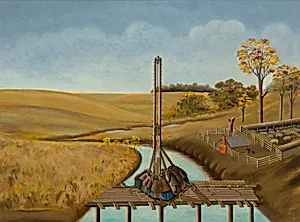
Women Operating the Pile Driver
c. 1939
Medium
oil on board
Dimensions
Overall: 43.8 x 58.4 cm (17 1/4 x 23 in.) framed: 53 x 68.6 x 2.5 cm (20 7/8 x 27 x 1 in.)
Classification
Index of American Design
Department
CG-W
Museum
National Gallery of Art, Washington, D.C.
Credit
Index of American Design
Accession Number
1943.8.9527
Rights
Public Domain
Art Historical Context
In the heart of the New Deal era, *Women Operating the Pile Driver (c. 1939) captures a dynamic moment of American industriousness through the skilled hand of John Koehl, who rendered this oil-on-board work after the folk artist Olof Kr. Part of the prestigious Index of American Design—a Federal Art Project under the Works Progress Administration (WPA)—this piece belongs to a vast documentation effort from 1935 to 1942. Artists like Koehl meticulously recreated everyday objects and scenes of American folk art to preserve the nation's cultural heritage amid the Great Depression, now housed in the National Gallery of Art's collection. The painting depicts women confidently operating a massive pile driver, a symbol of construction and progress, echoing Krans' own vivid portrayals of Swedish immigrant life in 19th-century Bishop Hill, Illinois. Krans, a self-taught folk artist, chronicled communal labor and rural resilience in his original works, and Koehl's faithful reproduction highlights their bold compositions and earthy realism. Rendered in oil on board at 43.8 x 58.4 cm, the medium allowed for rich, detailed textures that emphasize the machinery's power and the workers' determination. This artwork holds cultural weight as a tribute to women's expanding roles in labor during economic hardship and the approach of World War II, while celebrating folk traditions through precise, museum-quality preservation. It invites us to reflect on America's innovative spirit and the unsung hands shaping its landscape.