
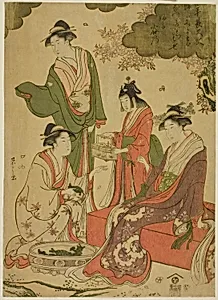
Women Viewing Cherry Blossoms
c. 1793
Medium
Color woodblock print; right sheet of oban triptych (center sheet: 1925.3088)
Dimensions
Approx: 33 × 23.2 cm (13 × 9 1/8 in.)
Classification
woodblock print
Department
Arts of Asia
Museum
Art Institute of Chicago
Accession Number
24061
Rights
Public Domain
Art Historical Context
Chôbunsai Eishi's *Women Viewing Cherry Bloss* (c. 1793) captures a serene moment of hanami, the cherished Japanese tradition of cherry blossom viewing. This color woodblock print, the sheet of an obanptych (with the center sheet in the Art Institute of Chicago collection), depicts elegant women in flowing kimonos admiring the delicate pink blooms. Measuring about 33 × 23.2 cm, it exemplifies the refined bijin-ga (pictures of beautiful women) for which Eishi, a master ukiyo-e artist of the late Edo period, was renowned. Eishi's work, produced during Japan's vibrant "floating world" culture, showcases the meticulous techniques of woodblock printing: intricate carving for bold lines and subtle gradients, layered colors from vegetable dyes, and precise registration for vivid depth. As part of a triptych, it would have formed a panoramic scene when joined with its companions, immersing viewers in an idyllic spring outing. Cherry blossoms hold profound cultural symbolism in Japan, evoking the ephemeral beauty of life (mono no aware). Eishi's graceful figures and soft, atmospheric rendering highlight this transience, offering museum-goers a window into 18th-century urban leisure and artistic innovation that influenced global printmaking.
About the Artist
Chôbunsai Eishi · 1756–1829
Chôbunsai Eishi, born Hosoda Tokitomi in 1756 to a prosperous samurai family of the Fujiwara clan in Edo, inherited a substantial stipend of 500 koku of rice annually. His grandfather had served as the shogunate's Treasury Minister, and upon his father Hosoda Tokiyuki's death in 1772, Eishi became family head while holding a position in Shogun Tokugawa Ieharu's palace from 1781. Unusually for a uk...