
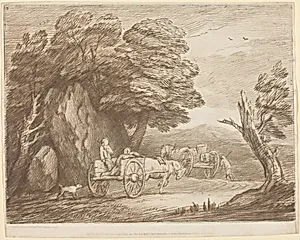
Wooded Landscape with Two Country Carts and Figures
1779/1780, published 1797
Medium
soft-ground etching printed in brown on wove paper
Dimensions
plate (image): 29.9 × 39 cm (11 3/4 × 15 3/8 in.) plate (text): 2 × 39.6 cm (13/16 × 15 9/16 in.) sheet: 32 × 40 cm (12 5/8 × 15 3/4 in.)
Classification
Department
CG-E
Museum
National Gallery of Art, Washington, D.C.
Credit
Andrew W. Mellon Fund
Accession Number
1976.39.1
Rights
Public Domain
Art Historical Context
Thomas Gainsborough, one of Britain's foremost 18th-century artists, captures the serene beauty of the English countryside in *Wooded Landscape with Two Country Carts and Figures*. Created around 1779–1780 and published in 1797 by the influential print publishers John and Josiah Boydell, this work reflects Gainsborough's mastery of landscape painting. Renowned for his fluid, atmospheric Rococo style—bridging the elegance of the 18th century with emerging Romantic sensibilities—he often depicted rural idylls teeming with rustic charm, evoking a nostalgic harmony between humans and nature. Rendered as a soft-ground etching printed in warm brown ink on wove paper, the print measures nearly 30 × 39 cm at its plate image. Soft-ground etching, a refined intaglio technique Gainsborough championed, uses a softer acid-resistant ground that allows for delicate textures—like the dappled foliage and cart wheels—by impressing objects directly onto the plate. This method translates his oil paintings into accessible prints, preserving their luminous quality and subtle tonal gradations on smooth wove paper, a durable 18th-century innovation. Published by the Boydells, who popularized British art through affordable editions, this piece at the National Gallery of Art (acquired via the Andrew W. Mellon Fund) highlights the era's print boom. It invited middle-class audiences to own a slice of Gainsborough's pastoral poetry, underscoring prints' role in democratizing high art during the Enlightenment.