
Work Table
Unknown Artist
1800–1810
Medium
Bird’s-eye maple, mahogany with yellow poplar, white pine
Dimensions
29 3/4 x 19 x 16 1/8 in. (75.6 x 48.3 x 41 cm)
Classification
Work table
Culture
American
Department
The American Wing
Museum
Metropolitan Museum of Art, New York, NY
Credit
Sansbury-Mills Fund, 1954
Accession Number
54.81
Rights
Public Domain
Art Historical Context
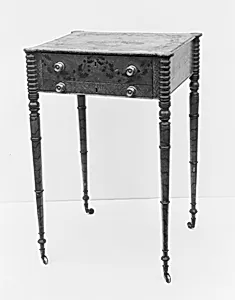
This delicate Work Table, crafted between 1800 and 1810 by an unknown American artisan, exemplifies the refined furniture of the early Federal period. Measuring a compact 29 3/4 x 19 x 16 1/8 inches, it features a luxurious veneer of bird’s-eye mapleprized for its shimmering spotted grain that mimics a starry sky—over a mahogany frame, with yellow poplar and white pine secondary construction. Such materials highlight the era’s growing access to imported hardwoods and the skill of regional cabinetmakers, often in urban centers like New York or Philadelphia. Work tables like this were essential in middle- and upper-class households, designed primarily for women’s domestic pursuits such as sewing, embroidery, or letter-writing. The piece’s slender legs and foldable top reflect neoclassical influences, blending functionality with graceful proportions inspired by ancient Greek and Roman designs adapted for American tastes. Its presence in The Met’s American Wing underscores its role in documenting everyday luxury during a time of national expansion and cultural aspiration. Acquired through the Sansbury-Mills Fund in 1954, this table invites visitors to imagine the quiet industry of early 19th-century life, where beauty elevated the mundane. A testament to anonymous craftsmanship, it survives as a charming relic of America’s decorative arts heritage.