
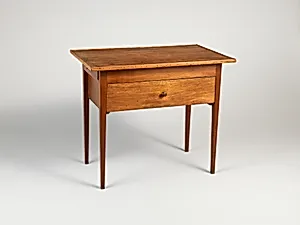
Work Table
Medium
Walnut, cherry, butternut, pine, basswood
Dimensions
25 x 29 1/8 x 18 1/8 in. (63.5 x 74 x 46 cm)
Classification
Work table
Culture
American, Shaker
Department
The American Wing
Museum
Metropolitan Museum of Art, New York, NY
Credit
Friends of the American Wing Fund, 1966
Accession Number
66.10.17
Rights
Public Domain
Art Historical Context
This elegant Work Table, crafted by members of the United Society ofievers in Christ’s Secondaring—better known as the Shakersbetween 1820 and 1850, exemplifies the pinnacle of Shaker furniture design. from a harmonious blend of woods including walnut, cherry butternut, pine, basswood, it measures compact 25 x ⅛ x 18⅛ inches, perfect for practical use in communal Shaker villages. Its clean lines and subtle proportions reflect the Shakers' commitment to utility without excess, a hallmark of craftsmanship. The Shakers, a celibate sect founded in 18th-century England and flourishing in the northeastern U.S., believed that all work should be an act of worship. Their furniture avoided decoration, favoring honest materials and precise joinery to create objects of enduring beauty and function. This table, likely used for sewing, writing, or domestic tasks, embodies their motto "Hands to work, hearts to God," prioritizing simplicity and perfection in everyday life. Housed in The Metropolitan Museum of Art’s American Wing, this piece highlights Shaker contributions to American decorative arts during a period of rapid industrialization. Acquired through the Friends of the American Wing Fund in 1966, it invites visitors to appreciate how spiritual ideals shaped functional design, influencing modern minimalism.