
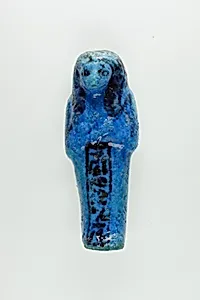
Worker Shabti of Nauny
Unknown Artist
ca. 1050 B.C.
Medium
Faience
Dimensions
H 8.8 × W 3.3 × D 2.2 cm (3 7/16 × 1 5/16 × 7/8 in.)
Classification
Shabti, worker, Nauny
Period
Third Intermediate Period
Department
Egyptian Art
Museum
Metropolitan Museum of Art, New York, NY
Credit
Rogers Fund, 1930
Accession Number
30.3.26.42
Rights
Public Domain
Art Historical Context
Step into the mystical world of ancient Egypt with the *Worker Shabti of Na*, a petite faience figurine from around 1050 B.C. Crafted during Dynasty 21 of the Third Period, this 8.8 cm tall servant statue was designed to labor eternally for Nauny, likely a noblewoman or priestess from Thebes. Shabtis like this one embodied the Egyptian belief in the afterlife, where the deceased needed magical helpers to perform menial tasks, freeing the soul for eternal bliss. Made of vibrant blue-green faience—a glazed composite of quartz, lime, and clay fired to a glassy sheen—this shabti exemplifies accessible artistry. Faience allowed for mass production of these protective figures, often inscribed with spells from the Book of the Dead to "activate" their service. Its compact form (just 3.3 cm wide) highlights the precision of Egyptian craftsmen, who molded and detailed it to depict a worker with tools at the ready. Acquired through the Rogers Fund in 1930, this piece at the Metropolitan Museum of Art offers a window into a transitional era when religious devotion shaped daily life and death. Imagine Nauny's tomb alive with hundreds of such loyal aides— a testament to ingenuity and faith that still captivates today.