
Worker Shabti of Nauny
Unknown Artist
ca. 1050 B.C.
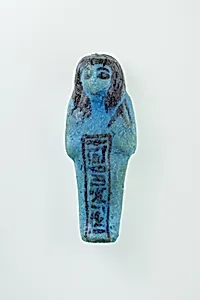
Medium
Faience
Dimensions
H. 8.7 × W. 3.2 × D. 2.2 cm (3 7/16 × 1 1/4 × 7/8 in.)
Classification
Shabti, worker, Nauny
Period
Third Intermediate Period
Department
Egyptian Art
Museum
Metropolitan Museum of Art, New York, NY
Credit
Rogers Fund, 1930
Accession Number
30.3.27.55
Rights
Public Domain
Art Historical Context
Step into the mystical world of ancient Egypt with the *Worker Shabti of Nauny*, a petite faience figurine from around 1050 B.C. Crafted during Dynasty 21 of the Third Intermediate Period, this shabti—meaning "answerer"—was designed as a magical servant for the afterlife. Belonging to Nauny, a noblewoman likely from Thebes, it represents one of many such figures buried with the elite to perform laborious tasks, freeing the deceased for eternal leisure. Inscribed with spells from the Book of the Dead, it was activated by ritual to "answer" its owner's call in the realm of Osiris. Faience, a vibrant glazed composite of quartz, lime, and clay, gives the shabti its signature turquoise hue, mimicking precious lapis lazuli while being affordable for mass production. At just 8.7 cm tall, this worker shabti exemplifies the period's refined miniaturism, with incised details capturing a mummiform figure hoe in hand, ready for eternal toil. Such artifacts highlight Egypt's enduring belief in immortality and the afterlife's daily grind. Acquired through the Rogers Fund in 1930, this piece from the Metropolitan Museum of Art's Egyptian collection offers a tangible link to a time when art blurred the line between life, death, and magic. Visitors are drawn to its serene expression, a testament to ancient ingenuity.