
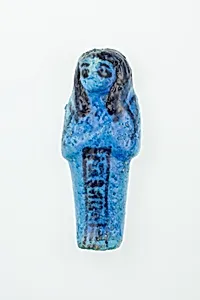
Worker Shabti of Nauny
Unknown Artist
ca. 1050 B.C.
Medium
Faience
Dimensions
H. 8.8 × W. 3.3 × D. 2.2 cm (3 7/16 × 1 5/16 × 7/8 in.)
Classification
Shabti, worker, Nauny
Period
Third Intermediate Period
Department
Egyptian Art
Museum
Metropolitan Museum of Art, New York, NY
Credit
Rogers Fund, 1930
Accession Number
30.3.28.23
Rights
Public Domain
Art Historical Context
This petite faience shabti, standing just under 4 inches tall, served as a "worker" figurine for Nauny, a high-ranking from ancient Egypt's Third Intermediate PeriodDynasty 21, ca. 1050 B.C.). Shabtis like this were placed in tombs to act as magical servants in the afterlife, laborious tasks so the deceased could enjoy eternal leisure. Inscribed with spells from the Book of the Dead, they the Egyptian belief in an active immortality, where even the elite relied on these humble stand-ins for manual work. Crafted from faience—a glazed composite of quartz, lime, and copper that yields a vibrant turquoise hue— this shabti exemplifies the period's mastery of small-scale production. Faience mimicked costly lapis lazuli, making afterlife aides accessible to the nobility. Its mummiform shape, with crossed arms holding tools like a hoe and pickaxe, highlights standardized Third Intermediate Period conventions, blending functionality with symbolic potency. Acquired through the Rogers Fund in 1930, this artifact from the Metropolitan Museum of Art's Egyptian collection offers a window into Nauny's world, revealing how faith in the afterlife shaped daily artistry and ritual. A testament to enduring ingenuity! (198 words)