
Working-Class Couple
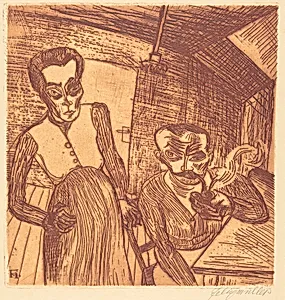
Medium
etching in red on buff wove paper
Dimensions
plate: 28.7 x 27.2 cm (11 5/16 x 10 11/16 in.) sheet: 41 x 30.8 cm (16 1/8 x 12 1/8 in.)
Classification
Department
CG-W
Museum
National Gallery of Art, Washington, D.C.
Credit
Gift of Ruth Cole Kainen
Accession Number
2006.160.2
Rights
Public Domain
Art Historical Context
Conrad Felixmüller's *Working-Class Couple* (1920) is a poignant etching in red ink buff wove paper, the quiet dignity of everyday laborers amid Germany's turbulent Weimar Republic era. Measuring 28.7 x 27.2 cm on the plate, this intimate print reflects the artist's roots in German Expressionism, a movement that emphasized emotional intensity and social critique through distorted forms and lines. Felixmüller, a key figure in the Dresden Secession Group 1919, often depicted the struggles of the working class, drawing from the post-World War I hardships of inflation, unemployment, and social upheaval. The etching technique—incising lines into a metal plate and printing with viscous red ink—lends the work a bold, tactile quality, heightened by the warm buff paper that evokes worn skin tones. This monochromatic palette intensifies the couple's weary expressions and huddled postures, symbolizing resilience amid adversity. As a print, it allowed wide dissemination, making art accessible beyond elite circles. Housed in the National Gallery of Art as a gift from Ruth Cole Kainen (Department CG-W), this piece exemplifies early 20th-century printmaking's role in amplifying voices of the proletariat, bridging Expressionism's fervor with emerging social realism. Visitors will appreciate its empathetic gaze on humanity's shared struggles.