
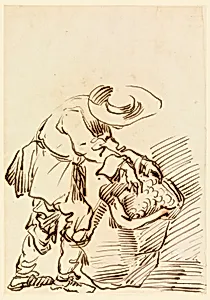
Working Peasant
Medium
figures
Classification
figures
Department
Smithsonian Collection
Museum
Smithsonian American Art Museum
Credit
Museum purchase through gift of various donors
Accession Number
1901-39-556
Rights
Public Domain
About this artwork
Research in Progress
Art Historical Context
**Working Peasant** by Marchionni (Italian, 1702–1786) invites visitors to glimpse 18th-century Italian artistry through a humble yet evocative figure. Crafted sometime between 1728 and1778, this work falls within Marchionni's mature career a sculptor and architect active in Rome and beyond. Classified simply as "figures," it likely represents a modeled or carved depiction of everyday labor, a motif that contrasted with the era's grand Baroque and emerging Rococo grandeur. Now housed in the Smithsonian American Art Museum—acquired through the generosity of various donors—this piece bridges European sculptural traditions with the museum's diverse collection. The title **Working Peasant** suggests a focus on the toils of rural life, a subject that humanizes the laboring class amid Italy's aristocratic patronage system. Marchionni's training in classical and Baroque styles would have informed his approach, emphasizing naturalistic form and expressive detail in three-dimensional media. Though research on this specific work is ongoing, it exemplifies how 18th-century artists occasionally turned to ordinary figures to explore texture, movement, and social realism. Pause here to appreciate the quiet dignity captured in this enduring sculpture—a testament to art's power to elevate the everyday.