
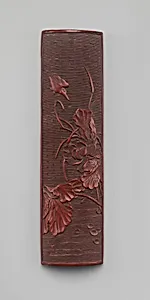
明 剔紅蓮池水禽紋臂擱|Wrist rest with kingfisher and lotus
Unknown Artist
1368–1644
Medium
Carved red lacquer
Dimensions
L. 9 in. (22.9 cm)
Classification
Lacquer
Culture & Period
China · Ming dynasty (1368–1644)
Department
Asian Art
Museum
Metropolitan Museum of Art, New York, NY
Credit
Gift of Florence and Herbert Irving, 2015
Accession Number
2015.500.1.104
Rights
Public Domain
Tags
Art Historical Context
This exquisite wrist rest, crafted during China's Ming dynasty (13681644), exemplifies the era's mastery of carved red lacquer, known as *tihong*. Measuring just 9 inches long, it served a practical yet refined purpose: supporting the arm of a scholar while writing or painting, preventing ink smudges on delicate paper. Produced anonymously by a skilled artisan, its surface reveals intricate carvings of kingfishers amid lotus ponds—motifs symbolizing harmony, purity, and prosperity in Chinese culture, where lotuses rise unsullied from mud and birds evoke graceful freedom. The technique of carved red lacquer was a pinnacle of Ming innovation, involving dozens of thin layers of lacquer applied over wood, then meticulously incised to expose underlying cinnabar-red hues against darker grounds. This labor-intensive process, requiring years to complete, highlights the dynasty's patronage of luxury crafts for the elite literati class. Now at the Metropolitan Museum of Art thanks to the generosity of Florence and Herbert Irving, this wrist rest invites us to appreciate the fusion of utility and artistry in imperial China, where everyday objects became emblems of philosophical elegance.