
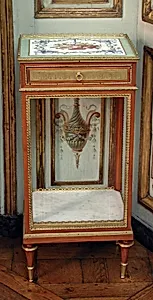
Writing and eating table
Medium
Oak veneered with tulipwood, gilt bronze, soft-paste porcelain, marble
Dimensions
Overall: 29 1/4 × 13 1/2 × 10 1/4 in. (74.3 × 34.3 × 26 cm)
Classification
Woodwork-Furniture
Culture
French, Paris and Sèvres
Department
European Sculpture and Decorative Arts
Museum
Metropolitan Museum of Art, New York, NY
Credit
Gift of Samuel H. Kress Foundation, 1958
Accession Number
58.75.56
Rights
Public Domain
Art Historical Context
This exquisite *Writing and Eating Table*, crafted around 1780 by the renowned Parisian cabinetmaker Martin Carlin in collaboration with the Sè Manufactory and bronze caster François Bouilliat, exemplifies the pinnacle of French luxury furniture during the late Louis XVI period. Compact at 29¼ × 13½ × 10¼ inches, its multifunctional design—serving both as a writing desk and dining surface—reflects the refined tastes of aristocratic interiors, likely a boudoir accessory for elegant ladies. The table's construction showcases masterful *ébénisterie* techniques: an oak core veneered in richly figured tulipwood for warmth and pattern, topped with veined marble, and adorned with gleaming gilt bronze mounts by Bouilliat. Delicate soft-paste porcelain plaques from the royal Sèvres factory, prized for their translucent glow and intricate painted motifs, are seamlessly integrated, highlighting the era's innovative cross-medium collaborations among top Parisian artisans. A gift to the Metropolitan Museum of Art from the Samuel H. Kress Foundation in 1958, this piece captures the opulence of pre-Revolutionary France, blending Neoclassical restraint with Rococo playfulness. It stands as a testament to the *menuiserie* and porcelain mastery that defined Europe's decorative arts golden age.