
Writing Board
Unknown Artist
570–525 B.C.
Medium
Wood, ink
Dimensions
H. 34 × W. 22 × Th. 3.8 cm (13 3/8 × 8 11/16 × 1 1/2 in.)
Classification
Writing Board
Period
Late Period, Saite
Department
Egyptian Art
Museum
Metropolitan Museum of Art, New York, NY
Credit
Rogers Fund, 1911
Accession Number
11.150.25
Rights
Public Domain
Art Historical Context
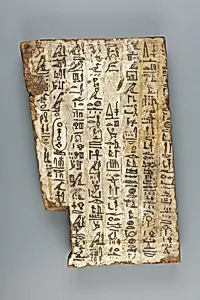
Step into the world of ancient Egyptian education with this intriguing *Writing Board* from Egypt's Late Period, specifically the Saite Dynasty (Dynasty 26, ca. 570–525 B.C.). Crafted from wood and inscribed with ink, this portable slab measures 34 × 22 × 3.8 cm, making it a practical tool for daily use. Acquired through the Rogers Fund in 1911, it now resides in the Metropolitan Museum of Art's Egyptian Art collection, offering a tangible glimpse into the scribal schools of the time. During the Saite era, often called Egypt's "renaissance," there was a revival of classical Old Kingdom styles amid political resurgence under foreign influences. Writing boards like this were essential for training young scribes—the backbone of Egyptian administration. Coated with a fine layer for ink adhesion, they allowed students to practice hieroglyphs and texts repeatedly; the ink could be washed off with water for reuse, an eco-friendly precursor to modern whiteboards. Though the artist remains unknown, the object's survival highlights the durability of these everyday artifacts. This unassuming board underscores the cultural primacy of literacy in ancient Egypt, where mastery of writing unlocked careers in temples, palaces, and tombs. Imagine a budding scribe honing skills under the Nile's shadow—such tools democratized knowledge, preserving a civilization's wisdom for millennia.