
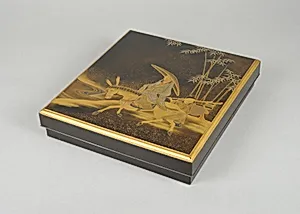
江戸時代 蘇東坡蒔絵硯箱|Writing Box with Chinese Poet Su Dongpo and Attendant
Unknown Artist
second half of the 18th century
Medium
Black lacquer with gold, silver, and red togidashimaki-e
Dimensions
H. 1 7/8 in. (4.8 cm); W. 8 3/4 in. (22.2 cm); D. 9 3/4 in. (24.8 cm)
Classification
Lacquer
Culture & Period
Japan · Edo period (1615–1868)
Department
Asian Art
Museum
Metropolitan Museum of Art, New York, NY
Credit
Bequest of Stephen Whitney Phoenix, 1881
Accession Number
81.1.170
Rights
Public Domain
Tags
Art Historical Context
This exquisite writing box (suzuri-bako), crafted in Japan's Edo period during the second half of the18th century, exemplifies pinnacle of lacquer artistry. Produced by an unknown master, it served as a portable desk accessory for scholars and samurai, housing an inkstone, brushes, and ink while symbolizing refined taste and intellectual pursuit. Adorned with scenes of the revered Chinese Song dynasty poet Su Dongpo ( Shi) and his attendant donkeys, the box reflects Japan's deep admiration for Chinese literati culture, blending poetic nostalgia with everyday utility. The medium—black lacquer enriched with gold, silver, and red togidashimaki-e—showcases a sophisticated technique where metal powders are sprinkled into wet lacquer, coated again, and meticulously polished to reveal shimmering designs. This labor-intensive process, perfected in the Edo era, created a luxurious, durable surface that glowed like jewels, making lacquerware a status symbol for the elite. Housed in the Metropolitan Museum of Art's Asian Art collection (bequest of Stephen Whitney Phoenix, 1881), this compact treasure (just under 10 inches long) invites us to ponder the cross-cultural exchange between China and Japan, where Su Dongpo's free-spirited legacy inspired generations of artists. A testament to Edo craftsmanship, it whispers of quiet moments of creation amid the era's vibrant urban life.