
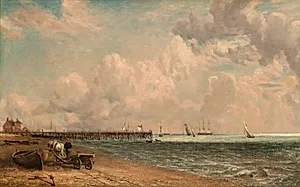
Yarmouth Jetty
1822
Medium
oil on canvas
Dimensions
overall: 31.7 × 50.8 cm (12 1/2 × 20 in.)
Classification
Painting
Department
CAB
Museum
National Gallery of Art, Washington, D.C.
Credit
Gift of Ruth Carter Stevenson in Honor of the Fiftieth Anniversary of the National Gallery of Art
Accession Number
2016.115.1
Rights
Public Domain
Art Historical Context
John Constable’s *Yarmouth Jetty* (1822) offers a luminous glimpse of the English coast. A leading figure of the Romantic movement, Constable devoted his career to capturing the changing effects of light, weather, and atmosphere in the British landscape. This small oil on canvas depicts the bustling wooden jetty at Great Yarmouth, Norfolk, where fishing boats and figures are set against an expansive sky—a subject that allowed the artist to explore the interplay of sea, wind, and cloud. Painted when Constable was at the height of his powers, the work demonstrates his preference for direct observation and loose, expressive brushwork. The modest scale (roughly 12½ by 20 inches) suggests it may have served as a study or keepsake, yet the painting conveys remarkable freshness and immediacy. Oil on canvas enabled Constable to layer translucent glazes that evoke the moisture-laden air of the North Sea. Acquired by the National Gallery of Art as a gift honoring its fiftieth anniversary, *Yarmouth Jetty* remains a treasured example of Constable’s ability to transform an ordinary harbor scene into a meditation on nature’s vitality and transience.
About the Artist
John Constable · 1776–1837
John Constable (1776-1837) was an English landscape painter whose naturalistic depictions of the Suffolk countryside revolutionized landscape painting and established him, alongside J.M.W. Turner, as one of England's greatest artists. His work pioneered the direct observation of nature that would later influence the French Barbizon school and, ultimately, Impressionism. Born in East Bergholt, Suf...