
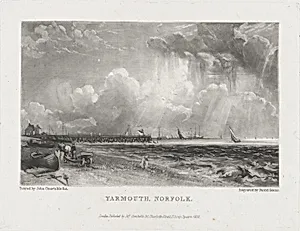
Yarmouth, Norfolk
Medium
Mezzotint; second state of six
Dimensions
Image: 5 1/2 × 8 9/16 in. (14 × 21.7 cm) Plate: 7 9/16 × 9 15/16 in. (19.2 × 25.2 cm) Sheet: 11 5/8 × 17 1/8 in. (29.5 × 43.5 cm)
Classification
Prints
Department
Drawings and Prints
Museum
Metropolitan Museum of Art, New York, NY
Credit
Harris Brisbane Dick Fund, 1943
Accession Number
43.75.10
Rights
Public Domain
Tags
Art Historical Context
**Yarmouth, Norfolk (1832) is a captivating mezzotint print capturing the rugged beauty of England's Norfolk coast, created by master engraver David Lucas after a composition by the renowned Romantic painter John Constable. Constable, celebrated for his luminous depictions of the British countryside and seascapes, sketched coastal scenes like this during his travels, emphasizing the sublime power of nature. Lucas, Constable's favored collaborator, translated these into prints as part of their ambitious *English Landscape Scenery*, aiming to make Constable's vision accessible to a wider audience through affordable reproductions. This second state of six showcases the mezzotint technique's velvety richness, where a roughened copper plate is scraped and burnished to produce deep blacks and subtle gradations—ideal for evoking the moody interplay of sea, sky, boats, and piers. Measuring modestly at 5½ × 8⅜ inches for the image, it invites intimate contemplation of elemental drama: waves crashing against piers, vessels bobbing in the harbor, and expansive skies hinting at fleeting weather. Acquired by The Metropolitan Museum of Art via the Harris Brisbane Dick Fund in 1943, this print exemplifies 19th-century innovations in printmaking that bridged fine art and popular dissemination, preserving Constable's fresh, plein-air spirit in enduring ink.
About the Artist
David Lucas|John Constable · 1802–1881
**David Lucas (1802–1881)** David Lucas was born in 1802 in Geddington Chase, Northamptonshire, the son of a farmer.) A chance encounter in 1820 led him to become a pupil of the renowned engraver Samuel William Reynolds, under whom he apprenticed in London until 1827, mastering the art of mezzotint engraving.) By 1827, Lucas had published his first mezzotints, showcasing his precocious talent for...