
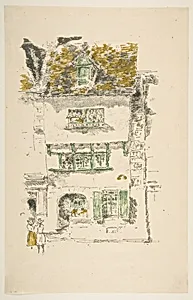
Yellow House, Lannion
Medium
Transfer lithograph with scraping; first state of three (Chicago); printed in black, green, gray and yellow on fine cream colored laid Japan
Dimensions
Image: 9 1/2 × 6 3/8 in. (24.2 × 16.2 cm) Sheet: 12 1/2 × 8 1/16 in. (31.8 × 20.4 cm)
Classification
Prints
Department
Drawings and Prints
Museum
Metropolitan Museum of Art, New York, NY
Credit
Harris Brisbane Dick Fund, 1917
Accession Number
17.3.235
Rights
Public Domain
Tags
Art Historical Context
James McNeill Whistler’s *Yellow House, Lannion (1893) captures a serene moment in the Breton town of Lannion,, where the artist vacationed that year. This transfer lithograph depicts a yellow house framed by human figures, ev everyday life with Whistler’s signature subtlety and elegance. As a pioneer of Aestheticism and “art for art’s sake Whistler prioritized tonal harmony and atmospheric effects, transforming ordinary scenes into poetic compositions. Printed in black, green, gray, and yellow on fine cream-colored laid Japan paper, this first state of three showcases Whistler’s innovative color lithography. The transfer technique—drawing on paper then transferring to a lithographic stone—allowed precise control, while scraping added delicate textures and depth. At 9½ × 6⅜ inches, its intimate scale invites close viewing, highlighting Whistler’s mastery of printmaking in his later career, when he produced acclaimed series blending impressionistic color with precise linework. Acquired by The Metropolitan Museum of Art in 1917 via the Harris Brisbane Dick Fund, this print exemplifies Whistler’s influence on modern graphics. It bridges 19th-century realism and abstraction, celebrating the beauty in humble architecture and fleeting human presence. A gem for print enthusiasts! (198 words)
About the Artist
James McNeill Whistler · 1834–1903
James Abbott McNeill Whistler (1834-1903) was an American-born painter and printmaker who became a leading figure in the Aesthetic Movement and pioneer of Tonalism and Japonisme. He revolutionized art by championing "art for art's sake" and treating paintings as visual equivalents of musical compositions, titling works as "arrangements," "harmonies," and "nocturnes" to emphasize formal qualities o...