
Yellow House, Lannion
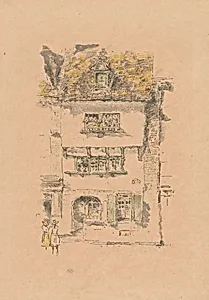
Medium
Transfer lithograph from six stones, in black (keystone), greenish gray, brown, green, yellow, and gray, with scraping, on tan wove Japanese vellum
Dimensions
Image: 24.2 × 16.2 cm (9 9/16 × 6 7/16 in.); Sheet: 37.9 × 28 cm (14 15/16 × 11 1/16 in.)
Classification
transfer lithograph
Department
Prints and Drawings
Museum
Art Institute of Chicago
Accession Number
139495
Rights
Public Domain
Art Historical Context
James McNeill Whistler, the renowned 19th-century American artist celebrated for his "art for art's sake" philosophy and subtle tonal harmonies, created *Yellow House, Lannion* in 1893. This transfer lithograph captures a quaint scene from the Brittany region of France, where Whistler traveled that year, drawn to its coastal landscapes and vernacular architecture. Produced during his later career, it reflects his shift toward innovative printmaking, blending Realism's everyday subjects with Aestheticism's emphasis on beauty and mood over narrative. The artwork's technical brilliance lies in its use of six lithographic stones—black (keystone), greenish gray, brown, green, yellow, and gray—applied with scraping for texture on luxurious tan wove Japanese vellum. Transfer lithography, Whistler's preferred method, involved tracing drawings onto the stones for precise, painterly effects, allowing complex color layering rare in prints of the era. At 24.2 × 16.2 cm, its intimate scale invites close viewing, evoking the atmospheric subtlety of his famous nocturnes. Housed in the Art Institute of Chicago's Prints and Drawings department, *Yellow House, Lannion* exemplifies Whistler's mastery of lithography as a fine art, bridging painting and print traditions. It offers visitors a window into fin-de-siècle experimentation, where everyday facades become harmonious compositions of light, color, and form.
About the Artist
James McNeill Whistler · 1834–1903
James Abbott McNeill Whistler (1834-1903) was an American-born painter and printmaker who became a leading figure in the Aesthetic Movement and pioneer of Tonalism and Japonisme. He revolutionized art by championing "art for art's sake" and treating paintings as visual equivalents of musical compositions, titling works as "arrangements," "harmonies," and "nocturnes" to emphasize formal qualities o...