
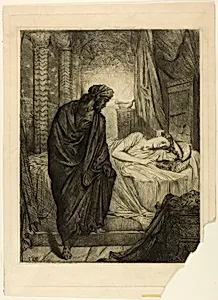
Yet She Must Die, plate eleven from Othello
Medium
Etching, engraving, roulette and drypoint on off-white China paper, laid down on cream laid paper
Dimensions
Image: 31.2 × 23.1 cm (12 5/16 × 9 1/8 in.); Chine: 31.8 × 25 cm (12 9/16 × 9 7/8 in.); Plate: 36.5 × 26.4 cm (14 3/8 × 10 7/16 in.); Sheet: 39.4 × 28.4 cm (15 9/16 × 11 3/16 in.)
Classification
etching
Department
Prints and Drawings
Museum
Art Institute of Chicago
Accession Number
40786
Rights
Public Domain
Art Historical Context
In the haunting "Yet She Must Die, eleven from Othello" (4), French artist Thé Chassériau captures a pivotal moment from Shakespeare's tragedy. At just 25, Chassériau—a prodigious talent blending the precise draftsmanship of Ingres with Delacroix's Romantic drama—created this etching as part of a rare series illustrating the play. The image evokes the heart-wrenching scene of Desdemona's, her innocence contrasting Othello's tragic delusion, reflecting 19th-century Europe's fascination with Shakespearean drama as a lens for exploring jealousy, fate, and human frailty. Chassériau's mastery shines in his mixed techniques: etching for fluid lines, engraving for crisp definition, roulette for velvety textures, and drypoint for expressive burrs that add emotional depth. Printed on delicate off-white China paper and laid on cream laid paper, the 31.2 × 23.1 cm image achieves luminous subtlety, ideal for intimate study. Housed in the Art Institute of Chicago's Prints and Drawings department, this work exemplifies how prints democratized grand narratives, bridging theater and visual art for broader audiences. This piece underscores Chassériau's brief but brilliant career, foreshadowing his later Orientalist works while highlighting the etching's role in 1840s France as a virtuoso medium for literary interpretation.
About the Artist
Théodore Chassériau · 1819–1856
Théodore Chassériau was born on September 20, 1819, in El Limón, Samaná, in the Spanish colony of Santo Domingo — present-day Dominican Republic — to a French father and a Creole mother. The family relocated to Paris in 1820, and the young Chassériau's exceptional talent was evident almost immediately. At just eleven years old, in 1830, he was accepted into the prestigious studio of Jean-Auguste-D...